
The 8 Best Apps for Making Math Videos in 2026
An honest comparison of the best apps for making math videos — Manim, CurvG, Desmos, GeoGebra, Keynote, Canva, After Effects, and Blender — matched to the kind of video you are actually making.
Choosing the best app for making math videos depends on one question more than any other: how much of the mathematics has to move? A talking-head lesson with a static slide needs a different tool than a 3Blue1Brown-style animation where a grid deforms under a matrix. This guide compares eight tools across that spectrum.
Disclosure up front: CurvG (this site) makes one of the tools below. We've kept the comparison factual and we tell you plainly where a competitor is the better choice.
The quick answer
- Animated math with full code control: Manim CE
- Animated math without coding: CurvG
- Live graph exploration on camera: Desmos
- Interactive geometry: GeoGebra
- Slide-based step reveals: Keynote or PowerPoint
- Template-style social clips: Canva
- Broadcast-grade motion design: After Effects
- 3D scenes: Blender
1. Manim CE — the precision engine
Manim Community is the open-source Python engine behind the 3Blue1Brown visual style. Every equation, transformation, and camera move is code, which means unlimited control and perfect reproducibility. The cost is real: you maintain a Python + FFmpeg + LaTeX environment, learn the API, and render on your own machine.
Best for: developers and creators who want frame-level control and don't mind programming. Price: free and open source.
2. CurvG — animated math without the toolchain
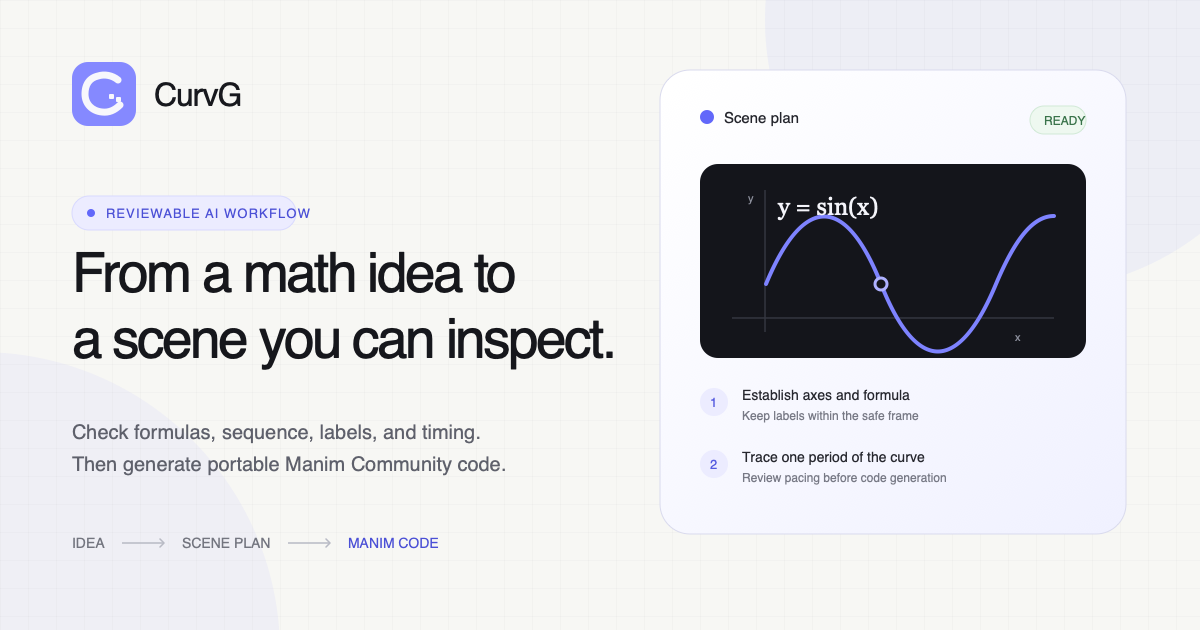
CurvG takes a written explanation goal, drafts a reviewable scene plan, generates Manim Community code, and renders the MP4 in the cloud. The workflow is deliberately staged: you check the mathematics, sequence, and timing before rendering, and you can export the Python at any time — so there is no lock-in against moving to raw Manim later. Planning is free; new accounts include starter render credits.
That review step is the honest trade-off versus one-click video generators: slightly more reading, far fewer silently wrong animations. AI output still needs your judgment — CurvG makes the checking easier, not unnecessary.
Best for: teachers and math creators who want Manim-quality motion without maintaining Python. Price: free to start; cloud renders spend credits. See the free math video creator page for exactly what costs nothing.
3. Desmos — graphs that move while you talk
The Desmos graphing calculator animates parameters with sliders, and a screen recording of that exploration is often the fastest possible math video. It doesn't produce standalone rendered animations, and visual styling is limited — but for "watch what happens as a grows", nothing is quicker.
Best for: live parameter exploration, homework help clips. Price: free.
4. GeoGebra — interactive geometry on record
GeoGebra shines for compass-and-straightedge constructions, transformations, and 3D solids. Like Desmos, the usual video workflow is screen recording an interaction. Its applet ecosystem is enormous, so you can often start from an existing construction instead of building your own.
Best for: geometry lessons and interactive demonstrations. Price: free for personal, non-commercial use.
5. Keynote / PowerPoint — the underrated step-revealer
For proof walk-throughs where lines of algebra appear one at a time, slide software with motion transitions (Magic Move in Keynote, Morph in PowerPoint) is genuinely good — and your institution almost certainly already licenses it. Equations are static images, so nothing continuously deforms, but step reveals cover a large share of classroom needs.
Best for: derivations, annotated worked examples. Price: included with macOS / Microsoft 365 plans.
6. Canva — fast social clips with light math
Canva is a template-first video editor: captions, stock motion graphics, and quick exports for Shorts or Reels. Mathematical notation support is thin (you'll paste equations as images), and nothing is truly computed — but for a 30-second concept teaser with music, it's efficient.
Best for: social media teasers around math content. Price: freemium.
7. After Effects — when design quality is the product
Adobe After Effects offers broadcast-grade typography, easing, and compositing. Equations are artwork rather than mathematics, so accuracy is entirely manual — a rescaled graph won't recompute. Serious channels often combine it with Manim: Manim for the math, After Effects for the polish.
Best for: professional motion design and channel branding. Price: paid subscription.
8. Blender — free 3D for the ambitious
Blender is the free path to 3D math scenes — surfaces, solids of revolution, vector fields in space — plus Grease Pencil for 2D. The learning curve is the steepest here, and precise mathematical animation requires scripting in Python anyway.
Best for: 3D-heavy explainers by patient creators. Price: free and open source.
Side-by-side
| Tool | Math actually computed? | Coding needed | Rendered video out | Price | | ------------- | ----------------------- | ------------- | ------------------ | --------------- | | Manim CE | Yes | Python | Yes (local) | Free | | CurvG | Yes (reviewable plan) | None | Yes (cloud MP4) | Free to start | | Desmos | Yes | None | Screen record | Free | | GeoGebra | Yes | None | Screen record | Free (personal) | | Keynote/PPT | No (static equations) | None | Yes (export) | Bundled | | Canva | No | None | Yes | Freemium | | After Effects | No | None | Yes | Paid | | Blender | Partly (via scripting) | Optional | Yes (local) | Free |
How to choose
- You teach daily and need one clip per lesson: start with Desmos or GeoGebra recordings; move to CurvG when you want rendered, reusable animations.
- You're building a YouTube explainer channel: Manim if you code, CurvG if you don't — the honest comparison covers exactly when raw Manim is the better pick.
- You need one polished social clip: Canva or Keynote will get you there fastest.
- You're not sure what to animate first: browse the math curve encyclopedia — every curve there converts into an animation brief with one click.
Whatever you pick, one principle transfers: review the mathematics before you render. Wrong-but-beautiful animations are the most expensive kind.